
Criminal Cases in the Menominee County Courts
Wisconsin Circuit Court has original jurisdiction over state-law felony and misdemeanor cases filed in Menominee County. Its public case numbers commonly use a filing year, a case-type code such as CF for criminal felony or CM for criminal misdemeanor, and a sequence number. Criminal traffic matters may use CT. The Menominee Clerk of Circuit Court keeps the local file, enters case events in the state court system, and supplies plain or certified documents. Menominee County has no incorporated city or village, so there is no city municipal criminal docket to add to this route.
Jurisdiction may change the court entirely. Menominee Tribal Court lists criminal, juvenile, motor vehicle, ordinance, and conservation matters within its separate judiciary. A serious offense arising in Indian country may instead produce a federal case in the Eastern District of Wisconsin. Police and detention records are different again. A person who knows only that an arrest occurred should not assume that WCCA contains the resulting case or that the first alleged offense became the filed charge.
The official Tribal Court jurisdiction and case-types page documents the separate route.
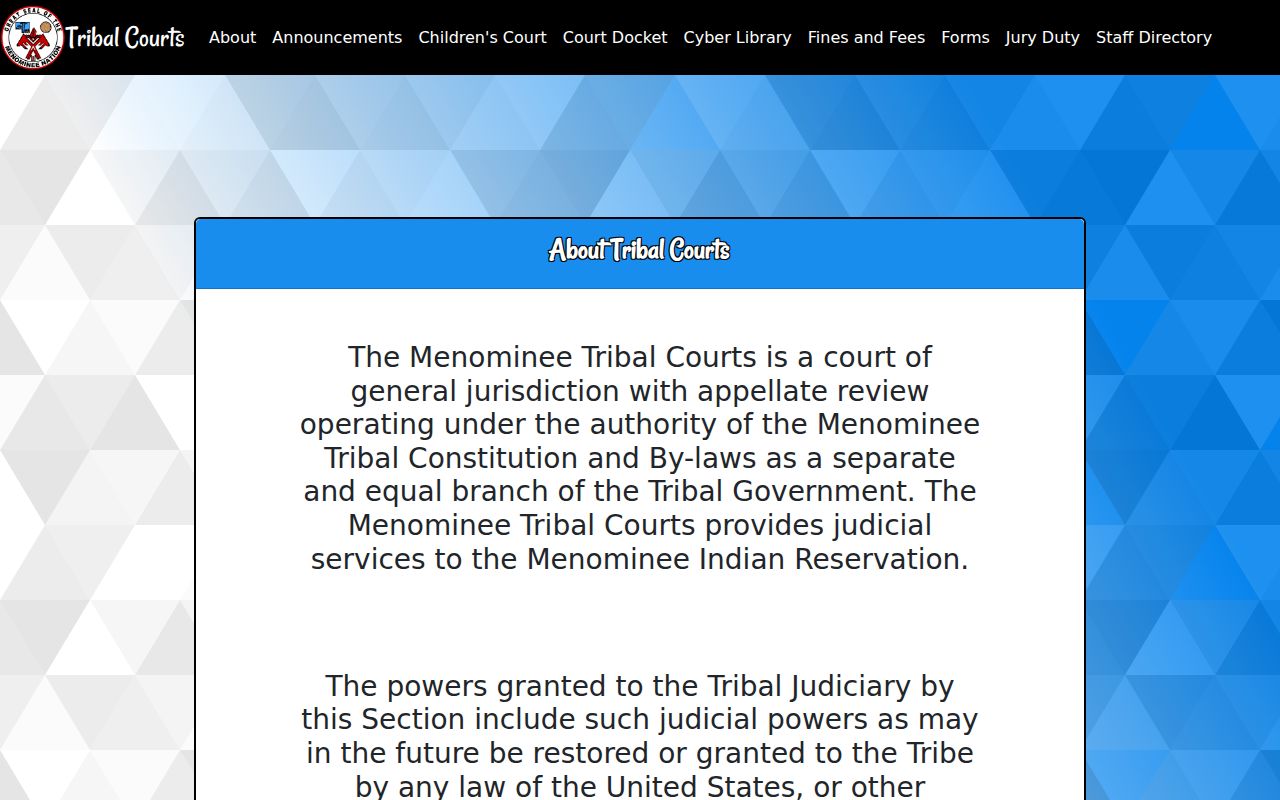
The listed types show why tribal criminal, ordinance, motor vehicle, and conservation records require their own court inquiry.
Menominee County's Paired Criminal Circuit
Menominee and Shawano Counties form a paired circuit in Wisconsin's Ninth Judicial Administrative District. Two circuit judges are based in Shawano and serve both counties. This arrangement creates an unusual split for a Menominee County criminal case: the file, payment, and record-search counter is in Keshena, while hearings are held at the Shawano County Courthouse. A correct case number therefore does not by itself identify the building where the next hearing will take place.
The Wisconsin court system's circuit information shows how the paired court is organized.
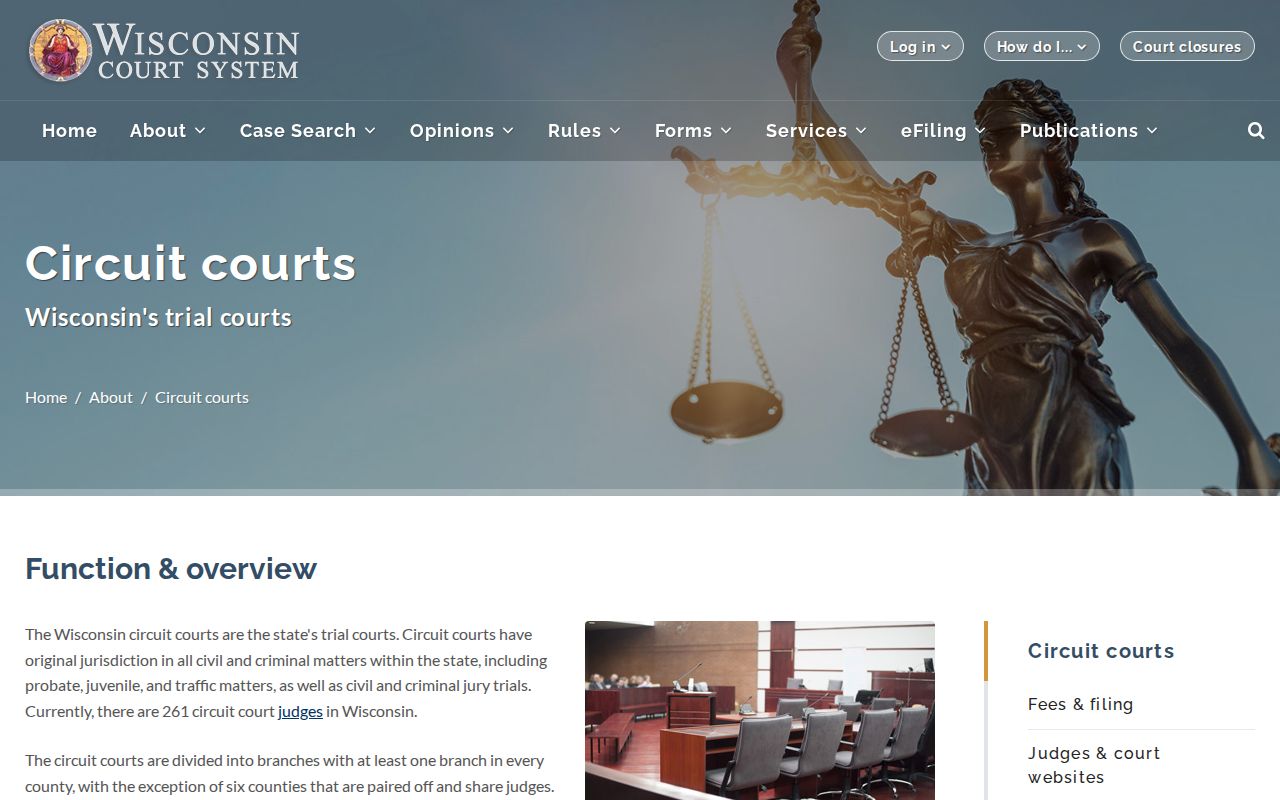
The official court view helps explain why Menominee County case records stay with the local clerk even though the judges and hearing rooms are based in Shawano.
How to Search Case Records
Begin with Wisconsin Circuit Court Access, or WCCA, for public state circuit summaries. Accept the site's terms, use an exact legal name when possible, and choose Menominee in the County field. A statewide repeat can catch a case filed somewhere other than the place of residence or arrest. Names are not unique, so compare more than one lawful, non-sensitive detail before treating a result as a match. WCCA is free, but it is not the official court record and may omit confidential, expunged, older non-automated, or policy-limited cases.
- Open WCCA and choose the advanced search. Select Menominee County and the relevant criminal case type.
- Enter the case number if known. Otherwise, use the surname, first name, and any sound narrowing fields.
- Open a plausible result and compare the county, filing date, case type, and other public identifiers.
- Read each charge and its disposition, then review the chronological court events instead of relying only on overall status.
- Record the case number. Contact the Menominee clerk for the complaint, judgment, certification, archive help, audio, or transcript information.
When WCCA returns nothing, check spelling and aliases, broaden the county filter, and consider whether the matter was too recent to be filed. Then route the inquiry by sovereign system: the Menominee clerk for state cases, Tribal Court for tribal cases, and PACER for federal cases. An arresting agency or detention office is the right fallback when no prosecutor has filed a case.
Search Menominee County Cases in WCCA
WCCA's advanced form supports both a party search and a direct case-number search. Its field labels can change, but the inspected public interface offered the full inventory below. Business Name is an alternate party route and is seldom useful for an individual defendant. Filing dates and case type can cut a long result list, while Party Type helps isolate a defendant from other roles.
| Field label | Type | Required | Options or format notes |
|---|---|---|---|
| Last Name | Text | Generally for party search | Spelling-sensitive legal surname |
| First Name | Text | No | Full name or initial narrows results |
| Middle Name | Text | No | Optional narrowing field |
| Birth Date | Date | No | MM/DD/YYYY; display rules apply |
| Business Name | Text | No | Alternate party search |
| Case Number | Text | No | Includes YYYYCFNNNNNN and YYYYCMNNNNNN |
| County | Dropdown | No | Select Menominee for local circuit files |
| Case Type | Dropdown | No | Includes CF, CM, and CT criminal types |
| Filing Date From/To | Date fields | No | Narrows by filing range |
| Party Type | Dropdown | No | Choose a case-dependent role |
| Search / Reset | Buttons | Not applicable | Submit or clear the criteria |
The WCCA criminal case search displays the working interface used for this inventory.
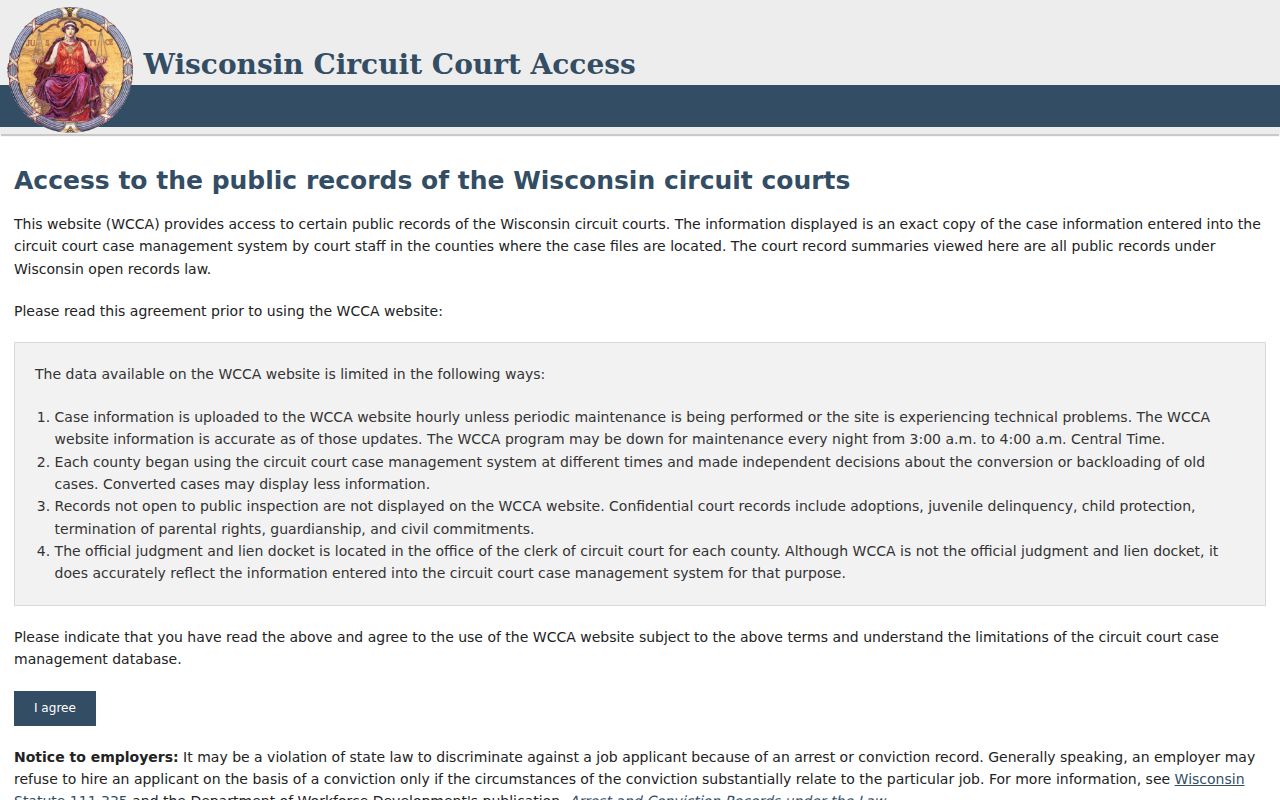
The county filter is especially useful here because a statewide name search may combine Menominee County case records with files from unrelated Wisconsin counties.
What the Case File Shows
A criminal case file records what the prosecutor filed and what the court did. That is different from a booking record, which captures initial custody and allegations, and from a Wisconsin DOJ CIB history, which links reported arrest and disposition cycles to an identity. WCCA can show a useful summary, but it does not provide every complaint, exhibit, transcript, or sealed document. The clerk's file controls when the exact language or a certified record matters.
| Case Number & Court | Identifies the filing year, case type, sequence, county, and court. |
|---|---|
| Charging Document | States the alleged facts, filed offenses, and cited Wisconsin laws. |
| Docket Entries | Chronology of filings, appearances, warrants, motions, orders, and review events. |
| Hearing Dates | Lists scheduled events, court official, branch, time, and sometimes location. |
| Disposition & Judgment | Shows each charge's final outcome and the resulting judgment. |
| Sentence & Conditions | Records custody, supervision, restitution, costs, and other ordered terms when public. |
Financial summaries may list assessments, payments, balances, or public restitution information. They should be checked against the signed sentencing document when precision matters. Likewise, the docket may note that a complaint or judgment was filed without making the whole document downloadable.
Menominee County Clerk Case Files Control
The Menominee Clerk is the custodian for the official county circuit file. Record the exact case number, then identify the item needed, such as the complaint, docket sheet, judgment of conviction, sentencing order, or certification. Ask about electronic delivery, turnaround, archives, transcript or audio access, and the cost before placing an order. No current Menominee copy or certification schedule was located in the official sources, so a quoted fee from another Wisconsin county should not be assumed here.
The Menominee Clerk of Circuit Court contact page provides the official local access point.
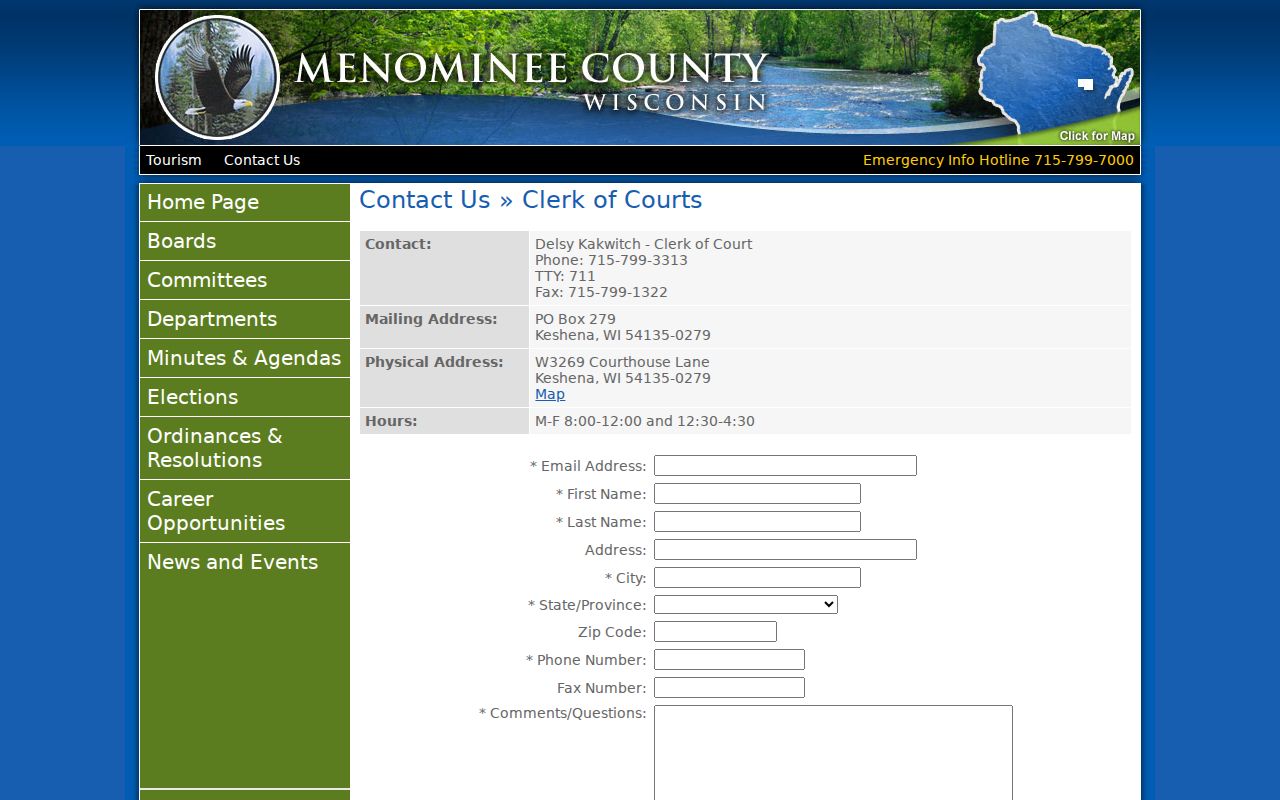
Its web form accepts requester contact details and comments, but it is a contact channel rather than a public case-copy ordering database.
Menominee Clerk of Circuit Court
W3269 Courthouse Lane
PO Box 279
Keshena, WI 54135-0279
715-799-3313
Monday through Friday, 8:00 a.m. to noon and 12:30 to 4:30 p.m.
Stages of a Criminal Case
For a Wisconsin matter, an arrest or citation is followed by prosecutor review. A filed complaint leads to an initial appearance, where the accused receives charge and rights information and the court addresses release. A felony can include a preliminary examination unless it is waived. Arraignment, motions, plea talks, trial or plea, judgment, sentencing, and possible appeal or postconviction work follow as the case requires. The docket may also record bond changes, competency proceedings, warrants, restitution, and later review hearings.
Case flow: Charges Filed → Arraignment → Pretrial → Plea or Trial → Disposition → Sentencing
No fixed local duration applies to every case. Charge level, motions, competency issues, trial preparation, and the paired court schedule can change the pace. A listed hearing date is more useful than a generic time estimate.
Tribal and Menominee County Criminal Cases
Menominee Tribal Court is not a branch of Wisconsin Circuit Court, and WCCA is not its docket. The Tribal Court describes itself as a separate judiciary with criminal and other jurisdiction. Its criminal rules address pleas and pretrial release. If an accused person refuses to plead, the judge enters a not-guilty plea. A no-contest plea results in an entry of guilt under the tribal rule. Rule 15 permits release subject to conditions unless probable cause indicates that release would create unreasonable danger.
The Menominee Tribal Courts home page is the direct starting point for the separate court system.
That official route prevents a no-result WCCA search from being mistaken for proof that no tribal criminal case exists.
Read Menominee County Case Dispositions
A case-level status can hide different results for separate counts. Read every charge line, its plea, any amendment, and its disposition date. A filed allegation is not a conviction. One count may be dismissed while another ends in a plea or verdict, and a sentencing entry may apply only to the surviving count. The signed judgment gives the strongest account of the court's final action.
- Disposition
- The final outcome of one charge, such as conviction, dismissal, or acquittal.
- Dismissed
- A charge ended without a conviction; the exact entry may affect whether refiling is possible.
- Acquittal
- A not-guilty result after trial.
- No contest
- A plea that permits conviction without an express admission of the charged facts.
- Judgment
- The court's formal decision, including the conviction and sentence when applicable.
WCCA financial entries can be useful, but they are not a substitute for the sentencing order. Ask the clerk for that document when the terms, balance, restitution, or conditions must be confirmed.
Menominee County Criminal Cases in Federal Court
Reservation conduct can create a federal record when federal Indian-country jurisdiction applies. Those cases are filed in the U.S. District Court for the Eastern District of Wisconsin, not in WCCA or Tribal Court. The responsible path depends on status, location, offense, and governing law. Tribal Police and the FBI may both take part in an investigation, while federal prosecutors file the court case. That cooperation does not merge the resulting agency and court records.
PACER requires an account and provides the federal docket search. Some filings may be sealed or otherwise restricted, and federal fee rules apply.
The PACER route is the needed federal layer when the facts point beyond Menominee County Circuit Court and Menominee Tribal Court.
Access & Restrictions
Wisconsin circuit summaries are broadly accessible, but public access has limits. Juvenile matters, victim identifiers, medical or mental-health material, confidential informant and security information, protected addresses, sealed warrants, and records covered by court orders may be restricted or redacted. Older files may also fall outside automated display. A missing WCCA result does not prove that no case exists or that expungement occurred.
The Wisconsin Public Records Law favors access to records held by Wisconsin authorities, subject to statutes, court rules, and exemptions. A requester may reasonably describe an existing record and ask the responsible authority to provide releasable portions. Tribal records follow tribal law, policy, and sovereignty rather than an automatic application of the county process. The Tribal Court Cyber Library supplies its computer-files policy and criminal rules. Federal court restrictions apply separately in PACER.
Wisconsin expungement under Wis. Stat. § 973.015 is narrow and generally must be ordered at sentencing for an eligible matter. It changes public circuit treatment after successful completion, but it does not guarantee that every police, tribal, federal, or repository record disappears.